Return to Help Index
| FAQ's | |
 |
|
| Are outboard fuel efficient? | |
Many modern outboard motors are designed to be fuel-efficient, providing more miles per gallon of fuel compared to older models. Manufacturers have developed advanced technologies, such as direct fuel injection, variable valve timing, and electronic fuel management systems, to improve fuel efficiency and reduce emissions. In addition to using a fuel-efficient outboard motor, there are several ways to further improve fuel efficiency, such as properly trimming the motor, maintaining the propeller, and using the right type of fuel. By following the manufacturer's recommended maintenance schedule and boating in a fuel-efficient manner, you can help reduce your fuel consumption and save money on fuel costs. It's important to consider fuel efficiency when selecting an outboard motor, as it can have a significant impact on your boating experience and operating costs. Ultimately, choosing a fuel-efficient outboard motor is a smart choice for both your wallet and the environment. Suzuki outboards are known for their fuel efficiency, thanks to advanced features like Lean Burn Control Technology and Suzuki Precision Control. These technologies help optimize fuel consumption and reduce emissions, resulting in a more environmentally friendly and cost-effective boating experience. Choose a fuel-efficient Suzuki outboard motor for your next boating adventure. |
|
| Can all outboard motors be used in saltwater? | |
Suzuki outboard motors are designed to be used for both fresh and saltwater, but be aware that specially for saltwater you do need to have some maintenance done after every use. Correct maintenance for an outboard motor used in saltwater includes regular flushing of the motor with freshwater after every use to remove any salt and debris that may have accumulated, as well as washing the exterior with a mild detergent and freshwater. It's also important to inspect the motor's anodes regularly and replace them if they are worn, as they play a critical role in protecting the motor from corrosion. Additionally, using a high-quality lubricant and changing it regularly can help extend the life of the motor. Proper maintenance is key to ensuring the longevity and performance of an outboard motor used in saltwater. |
|
| Can outboard motors freeze? | |
As temperatures drop, it's natural to wonder whether your outboard motor will freeze. Freezing can cause serious damage to your motor, so it's important to take the necessary precautions to protect it. Outboard motors can freeze if they are not properly winterized. When water inside the motor freezes, it can expand and crack engine blocks, freeze plugs, or other components. To prevent this, it's important to winterize your outboard motor before the temperatures drop below freezing. Winterizing your outboard motor typically involves flushing the motor with fresh water, draining the lower unit gear oil, and adding antifreeze to the cooling system. It's also important to store your motor in a dry, cool place to prevent any moisture from getting inside and causing damage. In addition to winterizing your outboard motor, you can take other steps to protect it from freezing. For example, you can use a motor cover to keep snow and ice from accumulating on the motor, which can cause damage over time. Overall, outboard motors can freeze if they are not properly winterized or protected from the elements. By taking the necessary steps to protect your motor, you can ensure that it stays in good condition and performs reliably for years to come. |
|
| Can outboards lay on their side? | |
Yes. You can lay your outboard motor on its side, but it is important that you lay it on the correct side. Your Suzuki outboard will include decals on the motor itself showing which direction you can lay your motor for transport or storage. Please see owner's manual for additional information on transporting and storage of your outboard. |
|
| Do outboards come with stick/tiller or remote control? | |
Outboard motors are available with different control options to suit your boating needs and preferences. Stick or Tiller handle controls are a popular option for smaller boats, allowing the operator to steer and control the throttle from a central position. However, many outboard motors also come with remote control options, which provide greater flexibility and comfort, particularly on larger boats. Remote control options typically include a steering wheel, throttle and shift levers, and electronic controls for improved precision and ease of use. Whether you choose stick tiller or remote control, it's important to select the right control option for your specific boating needs to ensure a safe and enjoyable experience on the water. |
|
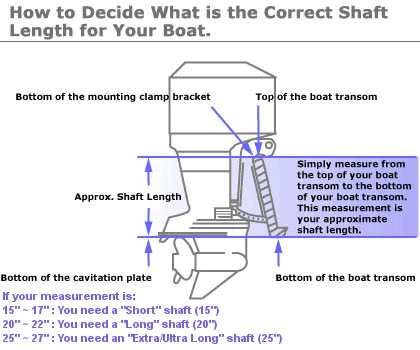
| How to measure the “Shaft Length” | |
See the diagram below. You will measure from the top of your transom to the bottom of your keel. If this measurement is 15" to 17" long, you'll need to purchase a Suzuki outboard motor with a "Short" shaft. If this measurement is 20" to 22" long, you'll need a Suzuki "Long" shaft outboard. To measure the outboard shaft, start from the bottom of the engine mounting bracket and measure the cavitation plate on the lower unit. Generally, most boats need either a short or long shaft, although some boats require a 25" shaft (ultra-long shaft) outboard motor. PLEASE NOTE: |
|
| Is there anything I need to do before using my outboard for the fist time? | |
The lower unit gear lube is pre-filled from the Suzuki factory with no assembly is required, and the propeller comes pre-installed for your convenience. If you purchase an electric start model, your outboard will include battery leads pre-installed from the factory (battery not included). You simply connect the battery leads to your battery. Read the owner's manual carefully prior to operation. The owner's manual contains important information regarding the break-in period, safety, and proper use of your Suzuki outboard engine. |
|
| Outboards vs inboards boat motor | |
Outboards and inboards are two types of boat motors that may seem similar, but they have some important differences. While both types of motors have their pros and cons, they are essentially the same animal but different breed. In this article, we will discuss the main differences between outboards and inboards, and the benefits of choosing an outboard for your boating needs. The Difference between Outboards and Inboards The main difference between outboards and inboards is their location on the boat. An outboard motor is mounted on the transom, or back, of the boat and is self-contained. In contrast, an inboard motor is located inside the boat and is typically mounted in the center, under the deck or cabin. Another key difference is the way they are powered. Outboards are typically powered by gasoline or diesel fuel, while inboards are often powered by diesel fuel. This difference in fuel type can affect the cost and availability of fuel, as well as the overall operating costs of the boat. Benefits of Outboards There are several benefits to choosing an outboard motor for your boat. One of the main advantages is that they are easy to install and maintain. Because they are self-contained, they are easier to service and repair than inboard motors. Additionally, outboards are more fuel-efficient than inboard motors, which can save you money on fuel costs in the long run. Another benefit of outboards is their versatility. They are available in a wide range of sizes and horsepower ratings, making them suitable for a variety of boat types and sizes. Additionally, because they are mounted on the transom of the boat, they are easy to remove and replace if needed. So, while outboards and inboards motor may seem similar, they have important differences that can affect their performance and cost. Outboards are a popular choice for boaters due to their ease of installation and maintenance, fuel efficiency, and versatility. By understanding these differences, you can make an informed decision when choosing a motor for your boat. |
|
| What is a “Kicker” motor? | |
A kicker motor is a small motor that generally refers to a model that is used to supplement a larger outboard motor and is often intended for trolling or going slow. They are also commonly used for sailboats as an auxiliary power source when wind conditions are not favorable or positioning the boat is important. These motors are typically 6 hp to 9.9 hp models with a 20 inch or 25 inch shaft. |
|
| Which outboard motor is the best? | |
Choosing the best outboard motor depends on various factors, including your specific boating needs, budget, and preferences. However, there are several top-rated outboard motor brands known for producing high-quality and reliable motors, including Yamaha, Honda, Mercury, Suzuki, and Evinrude. These brands offer a range of outboard motors with various horsepower options and features, such as fuel efficiency and advanced technology. When selecting the best outboard motor, it's important to consider your boating needs and usage, as well as factors like maintenance requirements and warranty coverage. Additionally, choosing a reputable dealer and following the manufacturer's recommended maintenance schedule can help ensure the longevity and performance of your outboard motor. Ultimately, the best outboard motor for you will depend on your specific needs and preferences, so it's important to do your research and compare options before making a purchase. |
|
| Which outboard motor is the quietest? | |
When it comes to outboard motors, noise levels can vary significantly depending on the brand and model. However, Suzuki is known for producing some of the quietest outboard motors on the market. Suzuki range of outboard motors features advanced noise reduction technologies, which help reduce noise and vibration for a quieter and more comfortable boating experience. Additionally, Suzuki offers a range of horsepower options and features, including fuel efficiency and reliability, making them a popular choice among boaters. If you're looking for a quiet outboard motor, Suzuki is a great option to consider. It's important to do your research and compare options to select the best outboard motor for your specific needs and preferences. |
|
| Which outboards is the most reliable | |
There are several outboard motor brands known for their reliability, including Yamaha, Honda, Mercury, Suzuki, and Evinrude. Each of these brands has a reputation for producing high-quality outboard motors that are durable, efficient, and perform well over time. However, the most reliable outboard motor for you will depend on your specific needs and usage. It's important to consider factors such as horsepower, fuel efficiency, and maintenance requirements when selecting an outboard motor. Additionally, choosing a reputable dealer and following the manufacturer's recommended maintenance schedule can help ensure the longevity and reliability of your outboard motor. Ultimately, the most reliable outboard motor is one that meets your needs and is properly maintained to maximize its lifespan and performance. |
|